Haiku Kurouchi
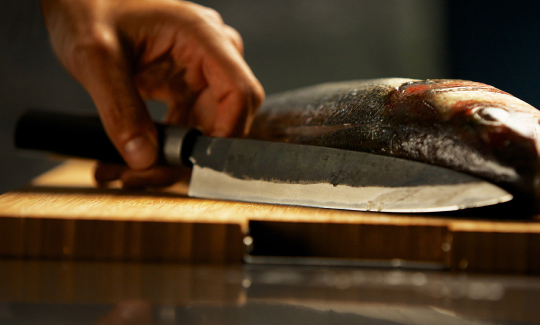
The raw beauty of Japanese blacksmithing
At a time when modern steels are enriched with numerous alloys designed to improve their corrosion resistance or mechanical performance, Haiku Kurouchi has chosen a different path. That of traditional steel – purer and more demanding – which reveals its full potential only in the hands of a craftsman capable of mastering fire, the hammer and time.
Low-alloy steel leaves less room for technology and more for craftsmanship. Every stage of the forging process, from heating to heat treatment, relies on the master blacksmith’s eye and experience. Here, the quality of the blade stems above all from the man who shapes it.
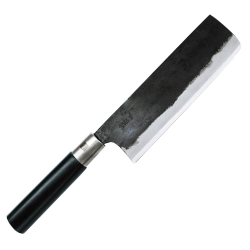
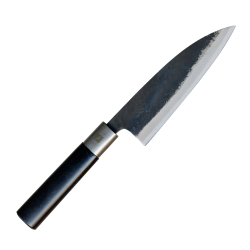
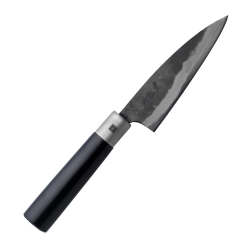
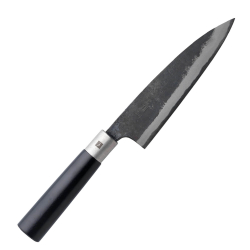
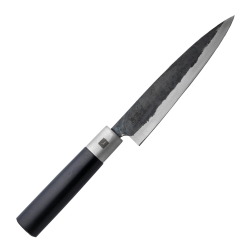
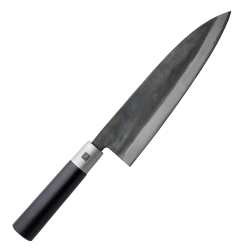
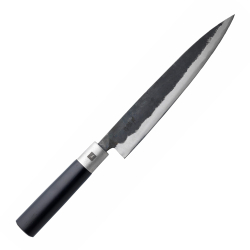
The Haiku Kurouchi blade is forged using a traditional three-layer construction, with two layers enveloping a core of Japanese Aogami (Blue Steel), renowned for its exceptional cutting power and remarkable ease of sharpening. Left in its raw, forged state, without being fully polished, it features the Kurouchi finish – that black patina resulting directly from the work of the fire. Its black-stained, hardened wooden handle is topped with a steel ferrule, secured using traditional methods.
Free-forged, just as in days gone by
Every Haiku Kurouchi knife is crafted in tiny workshops in Tosa, now Kōchi Prefecture, in southern Japan. This windswept region, with a centuries-long history of artisanal blacksmithing, upholds a tradition in which the human touch remains irreplaceable.
Here, each model is crafted by a specialist artisan who produces only a limited number of pieces. The blades are freely forged, without dies or industrial stamping, then shaped under the hammer using techniques passed down from generation to generation. This freedom of craftsmanship results in knives whose dimensions, thickness and texture vary slightly from one piece to another. These differences are not imperfections: they are the hallmark of entirely hand-crafted work.
Over the years, the steel develops a natural patina that tells the story of its use. Every mark, every shade of colour bears witness to the passing of time and reinforces the blade’s profoundly authentic character.
Kurouchi, the magic of fire
Kuro-uchi means ‘black forged’. It refers to the dark finish retained after forging, where the scale – a layer of iron oxide formed on the surface of the pieces during heating – still protects the upper part of the blade. Long reserved for the tools of Japanese craftsmen, this raw aesthetic has now become one of the most sought-after by enthusiasts of traditional cutlery.
When Haiku Kurouchi first appeared in Europe, it was one of the very first Japanese knives to showcase this highly distinctive finish. Its deliberately primitive appearance, remarkable sharpness and authenticity quickly earned it a reputation all of its own.
Even today, it can be found in the kitchens of some of the most demanding chefs, who are drawn as much to its efficiency as to its character – such as Christina Bau, the German chef and iconic figure of Japanese fusion cuisine, awarded three Michelin stars, or the young talent of the best restaurant in Norway, the Singaporean Mathew Leong, Bocuse d'Or 2021 and 2025 candidate. Each knife tells a different story: that of the craftsman who forged it and that of the person who will use it.
A living knife
As the Aogami steel core is not stainless, the Haiku Kurouchi requires special care. It develops a natural patina over time and through contact with food, forming a protective surface that further enhances its character. After use, it should be cleaned, dried thoroughly and, during prolonged storage, the blade should be protected with a light coating of camellia oil.
This requirement is also its greatest pleasure. Devoid of the alloying elements that make stainless steels more difficult to resharpen, its edge sharpens with remarkable ease on a water stone. Everyone can thus refine its edge over the years and shape a blade that reflects their own personality.
A living heritage
Production at the Tosa workshops remains small-scale. Nothing is automated, nothing is standardised. Each knife is the result of the work of a craftsman whose expertise, passed down through generations, remains intimately linked to his hand and his eye.
In a world where industrial manufacturing tends to standardise objects, Haiku Kurouchi remains a living testament to a rare craft. A blade forged in the traditional manner, destined to stand the test of time and to pass on, far beyond its practical function, a part of Japan’s cutlery heritage.
There are 7 products.
Active filters